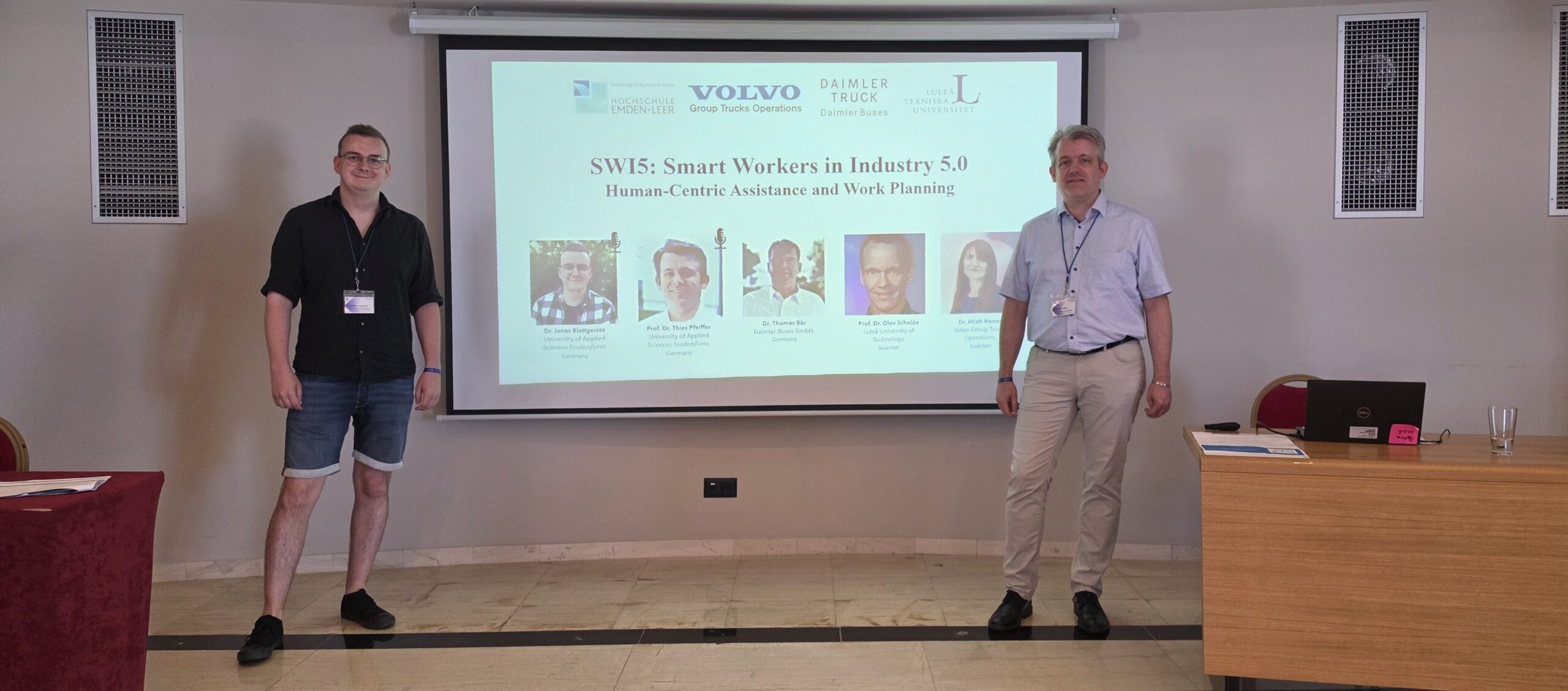
On July 15th, researchers and practitioners met at Crete for the first workshop on Smart Workers in Industry 5.0 (SWI5) during the PETRA 2026 conference. The workshop was organised by Dr Jonas Blattgerste and Prof. Dr Thies Pfeiffer, who also moderated it. Nine papers were presented, covering topics ranging from action monitoring at smart workstations to inclusive work in SMEs.
With regard to cognitive assistive technology (CAS), Valentin Knoben advocated improving reporting of CAS-related work by specifying the functional barriers, that are addressed, rather than relying on medical diagnoses alone. Valeria Osro presented a report on an exploratory survey of Italian SMEs which highlighted the discrepancy between the general awareness of the need for inclusion, particularly with regard to assistive technology, and its lack of implementation in industry.
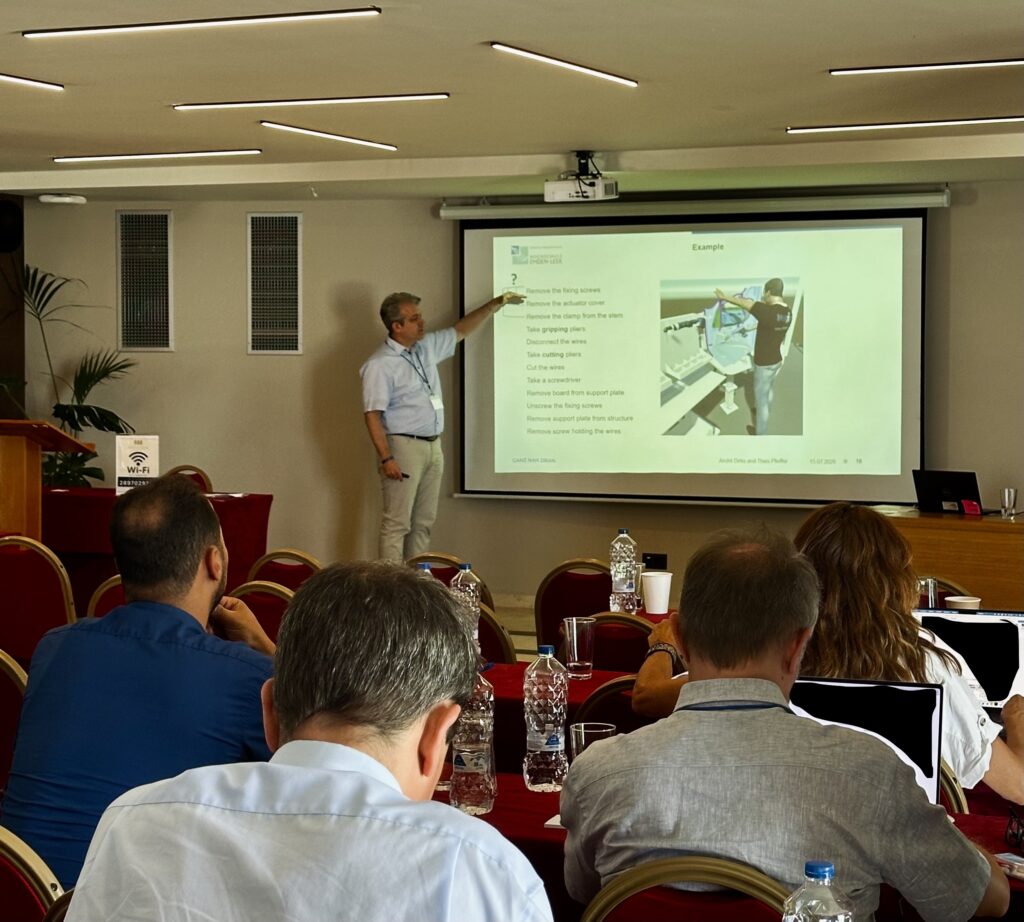
Dr. Jonas Blattgerste addressed the question on effective visualizations for step-by-step assembly instructions by presenting results from a systematic literature review. This gave insights into major gaps in particular regarding rigor experimental evidences on different success factors for the design of such visualizations. How the different requirements of novices and experts regarding the granularity of step-by-step instructions can be met by an adaptive chunking was tackled by Prof. Dr. Thies Pfeiffer. He reported on a dynamic programming approach to optimized addresse specific chunk of digital work instructions.
More technical aspects of smart workstations were addressed by the talk of Mario Thron, who presented results from a comparative study on different vision-based approaches to detect tool use at manual workstations, which contrasted traditional marker or color-based low profile algorithms with modern object detection or VLM-based approaches. Jan Bohnerth’s presentation went even further and detailed problems induced by latencies of multimedia transport of motion capturing data and discussed approaches for compensation.
The scheduling of jobs to workers or of workers to stations is also a topic under active research. Endre Eros presented an evaluation of an Integer Linear Programming approach for multi-dimensional scheduling using real-world data, underlining the potential of the approach. Hacane Hechehouche on the other hand, used information on worker’s skill-specific level of expertise to present tailored instructions and presented results from a small pilot study.
Finally, Hacane also presented work on making AAS accessible for human querying by transforming AAS models into RDF-based knowledge-graphs, which makes the stored knowledge operable for queries using the SPARQL query language. Users can now formulate queries in natural language, that are then transformed to SPARQL queries againt that knowledge-graph with the help of a LLM.
Overall, the workshop successfully brought together researchers and research questions spanning a wide range of topics that engineers face when implementing manual assembly processes in various industries. These industries range from individual workstations and smaller SMEs to larger car or bus manufacturers with complex process chains comprising tens to hundreds of stations.