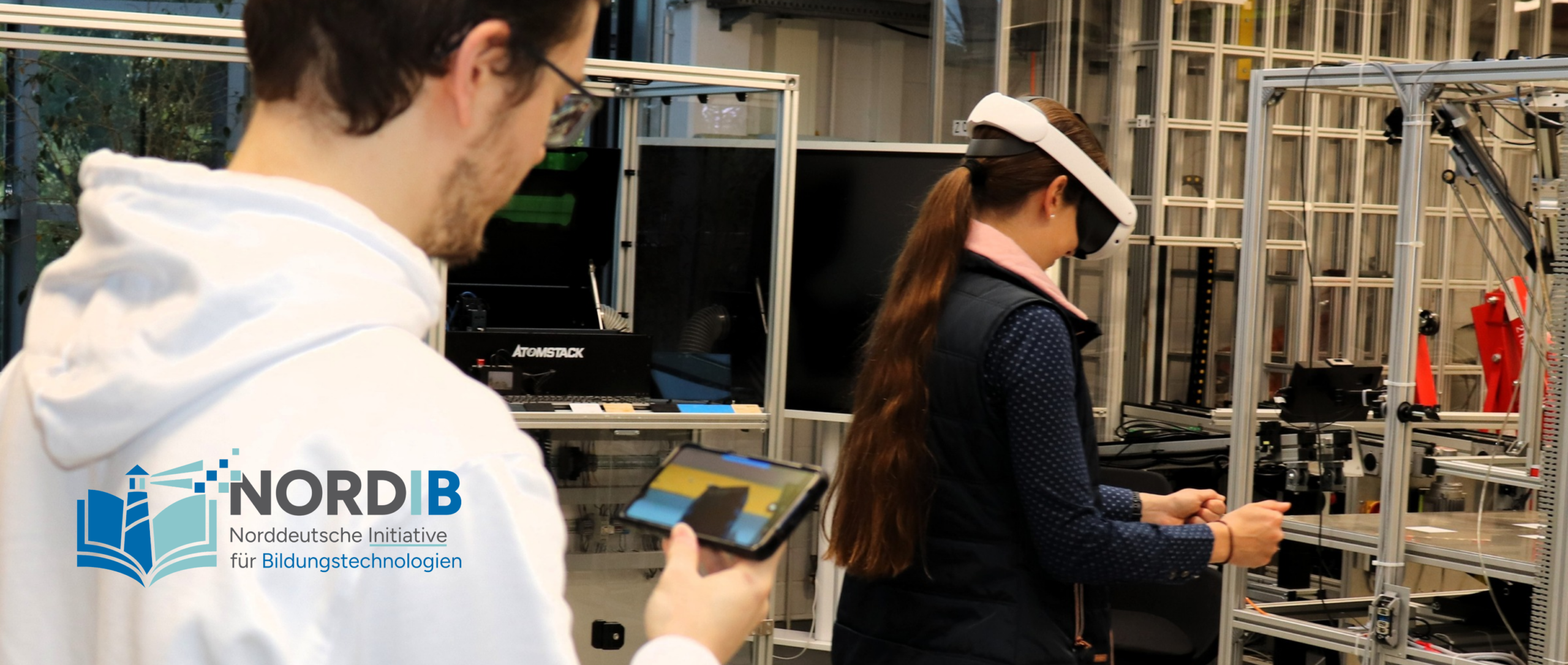
IT security is important, especially in recent years, with increasingly capable AI models, but It is not always seen as a particularly exciting topic to learn. In practice, that often leads to compliance problems. In their student project, Moritz Rindermann and Julian van Dyken asked how such topics could be taught more interactively. They conceptualized, implemented and evaluated an immersive Virtual Reality prototype towards answering this question in their project.
The prototype builds on the ICAP framework, which emphasizes that learners benefit most when they move from passively receiving information to actively engaging with it and constructing their own understanding. In Julian & Moritz’s prototype, learners read short learning units on a virtual tablet, answer quiz questions, and then apply what they learned in a scenario on working from home and data backup. The two also explored how established methods like concept mapping can be used for active learning in VR: learners arrange key terms as sticky notes on a virtual whiteboard and build their own structure of the topic. In their backup module, the abstract “3-2-1 backup rule” becomes a physical task. Learners use hand tracking to pull hard drives from the server, copy, and test them, and carry them to a safe or prepare them for off-site storage. Following ideas from embodied learning, the backup rule becomes something learners do rather than something they only read or hear about, which links the concept to their own actions and memories. Immersive VR is particularly well suited to this.
A first evaluation with students from a Business Informatics master’s course, gave encouraging results. Participants enjoyed the experience. In non-representative preliminary feedback, they reported having learned about backups and IT security in general and said they felt actively engaged in the learning process. Most rated the application as better than a traditional lecture on the topic would be, and the hands-on backup module stood out as their favorite part of the experience. The longer reading passages were seen as an area for improvement, which points future iterations towards shorter texts and more hands-on modules.
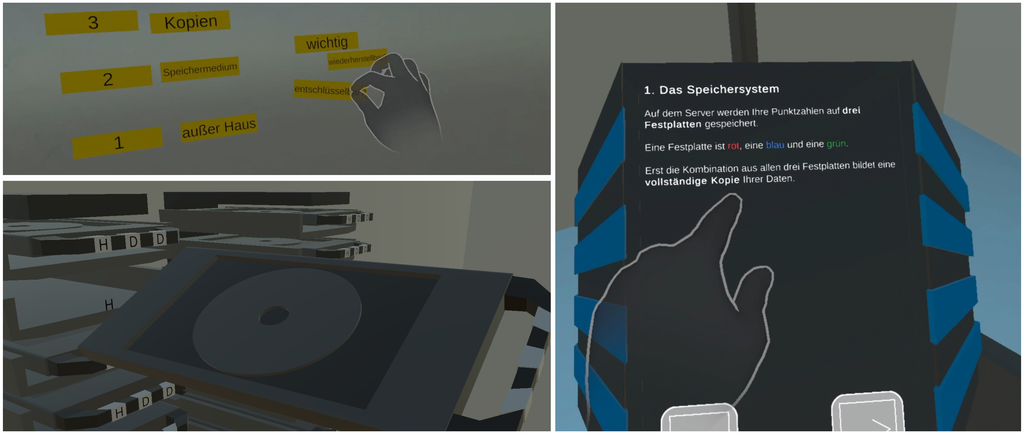
Figure 1. Top left: Interactive concept mapping, where learners structure key terms on a virtual whiteboard. Bottom left: The backup module, which explores how the abstract 3-2-1 backup rule can be turned into physical interaction. Right: The interactive learning tablet that guides learners through the unit.
This project is one of the student projects within NORDIB and was supervised by Prof. Dr. Patrick Felke and Prof. Dr. Eva-Maria Schön. It is a good example of how student projects can explore didactic questions in a hands-on way, and the results give us a useful starting point for further work on active learning in virtual worlds.
If you are a student interested in doing projects with us in the Mixality Lab, check out our teaching page.