The Challenge
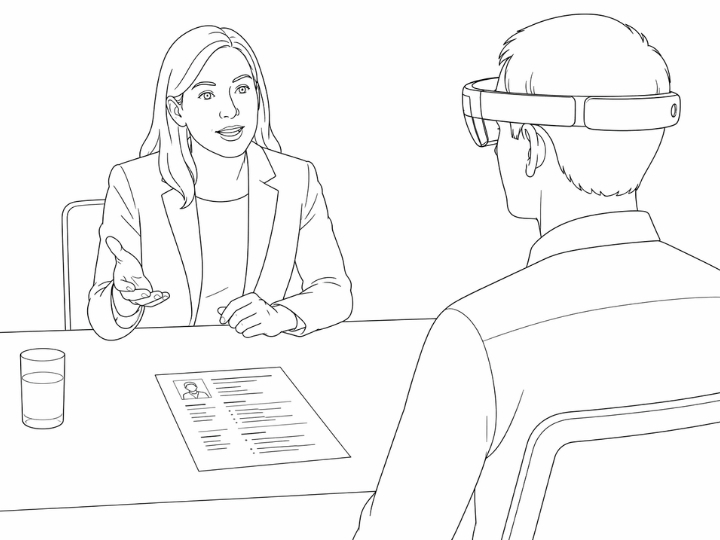
Psychological assessment combines the systematic collection and interpretation of information about a person’s behavior and abilities for the preparation of practical decisions (e.g. personnel selection) with methodological and statistical foundations (psychometrics). In higher education, this creates a difficult teaching situation: practical elements such as simulated personnel selection interviews are often valued as realistic, but they are costly to stage, limited in variety, and difficult to update. At the same time, more technical topics of psychological assessment such as psychometrics, test development, and adaptive testing are often perceived by students as abstract and hard to grasp.
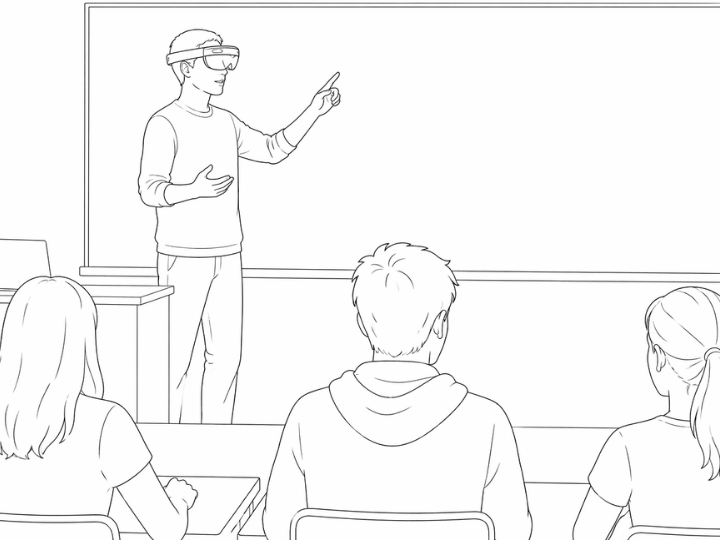
Augmented reality offers a promising way to address both sides of this challenge. It can make invisible decision processes more tangible, visualize complex diagnostic information directly in context, and create more interactive learning situations than static teaching materials or conventional classroom formats. In this way, AR may help bridge the gap between methodological rigor and practice-oriented teaching in psychological assessment.
Research Questions
Project ARAS investigates how augmented reality can support the teaching of psychological assessment in ways that are both educationally meaningful and technically feasible. A central question is how AR scenarios can be designed to improve students’ understanding, reflection, and engagement across a field that ranges from interpersonal diagnostic situations to abstract psychometric procedures. To this end, the project focuses on two exemplary scenarios from personnel selection (for another example at the University of Applied Sciences Emden/Leer see Pries & Schreiber, 2023) and the measurement of cognitive ability (mental rotation; Nolte et al., 2024) in order to cover the content breadth of the psychological assessment.
Project ARAS
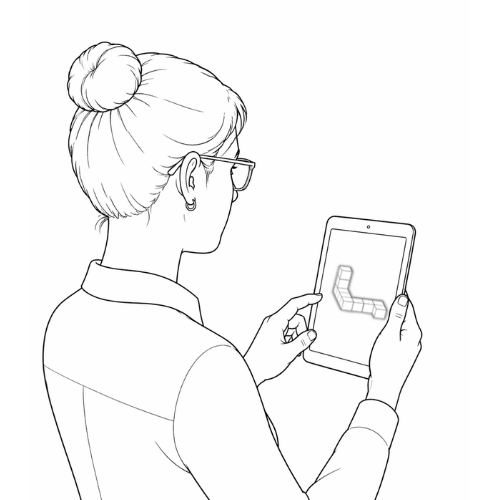
ARAS develops and evaluates two AR-supported teaching modules for higher education in psychological assessment. In the first module, students engage with an interview-based selection scenario that supports collaborative interpretation and reflection on diagnostic decisions. In the second, students work with an AR-enhanced representation of a mental rotation test, enabling complex psychometric procedures to be communicated in a more accessible and application-oriented way.
The project combines conception, technical development, pilot testing, classroom deployment, and evaluation. Students are involved not only as learners, but also in the co-conception and reflection of the scenarios. The broader aim of ARAS is to understand and evaluate how AR-based teaching formats can be designed, tested, and documented for sustained use in psychology-related higher education contexts, while also preparing the resulting materials for broader educational reuse.
Funding
Project ARAS is funded by Stiftung Innovation in der Hochschullehre through the Freiraum 2026 programme.
Responsible Investigators

Prof. Dr. Christian Spoden
Email: christian.spoden@hs-emden-leer.de

Carolin Hainke, M.Sc.
Email: carolin.hainke@hs-emden-leer.de