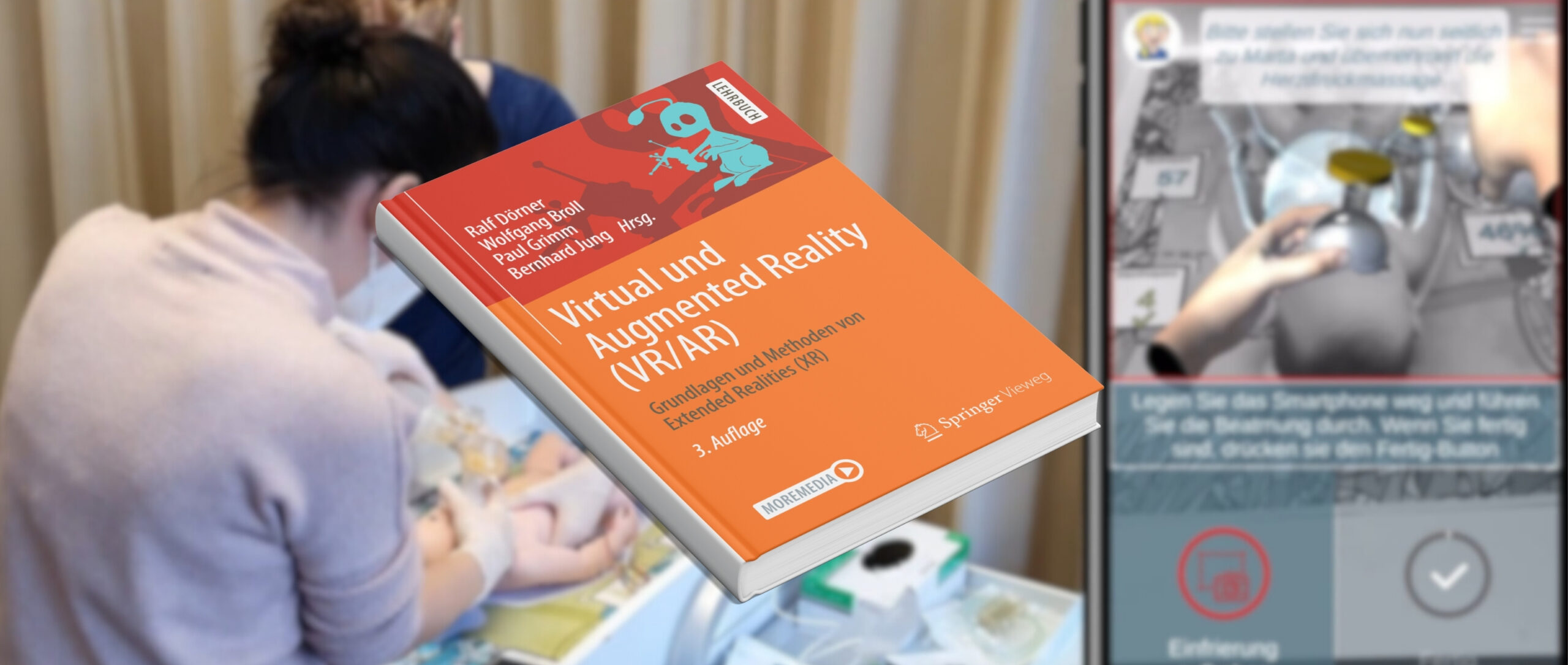
The third edition of one of the standard German textbooks in the Mixed Reality context, Virtual und Augmented Reality (VR/AR) (Springer Vieweg), has been published and includes a case study on the Heb@AR project. Authored by Thies Pfeiffer, Jonas Blattgerste, Annette Bernloehr, Kristina Vogel, and Nicola H. Bauer, the section “Heb@AR: Skalierbares AR-Training für Hebammen” outlines the development and deployment of augmented reality training applications for midwifery education.
The case study specifically addresses the role of handheld AR in procedural training. While head-mounted displays often dominate the discourse in mixed reality research, this case study emphasizes the practical utility of handheld devices. By utilizing a “Bring Your Own Device” (BYOD) approach, the project demonstrates how immediate scalability can be achieved in university curriculums, bypassing the logistical barriers typically associated with specialized hardware.
The technical foundation established during this research led to the development of TrainAR, an open-source authoring tool and framework designed to facilitate the creation of similar procedural AR training scenarios. If these concepts are of interest to you, or if you plan to implement similar scalable AR solutions, we invite you to explore the framework.
For further information on the project and the associated tools, please refer to the links below:
-
Book: https://link.springer.com/chapter/10.1007/978-3-662-72309-8_11
-
Heb@AR Project: https://mixality.de/hebar/
-
TrainAR Framework: https://mixality.de/trainar/